


Hulk (2003) & Iron Man (2008): Two Mad Scientists. One Built the MCU | EP26
Updated: Mar 10
Superhero stories have always been closely tied to science fiction. Many of Marvel’s most famous heroes begin as scientists whose experiments transform them in unexpected ways.
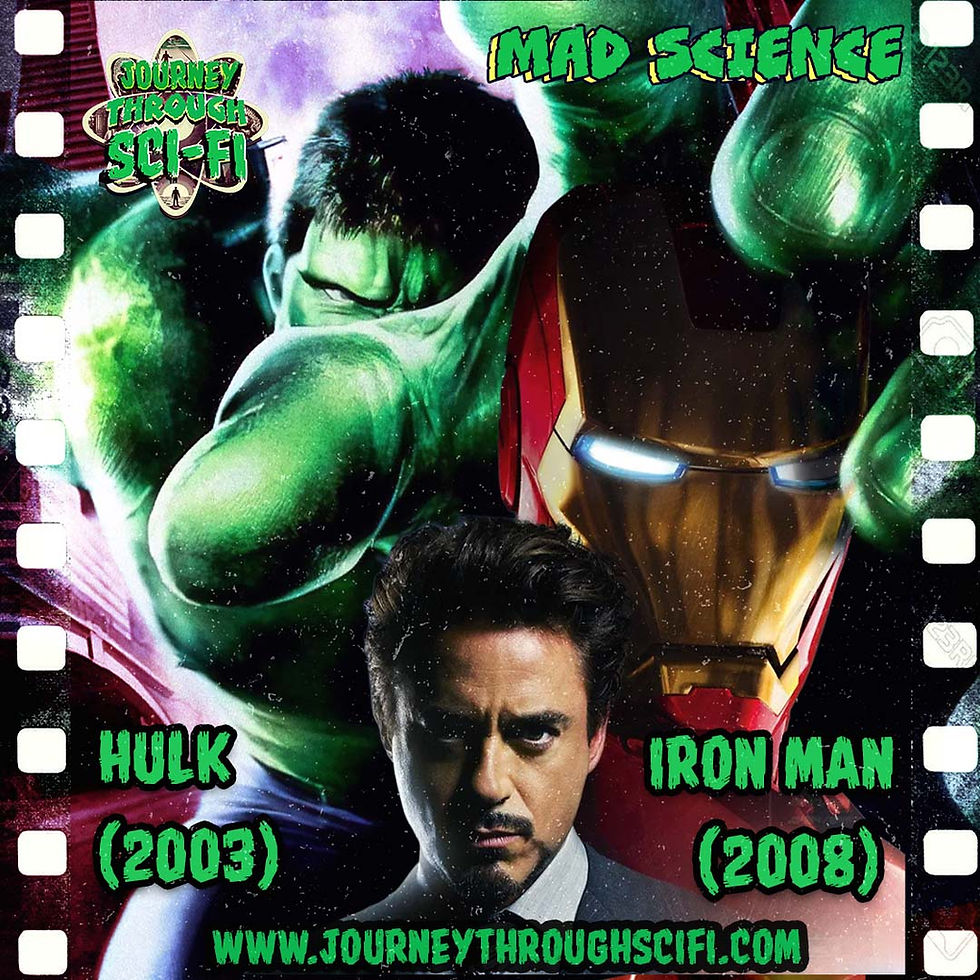
In this episode of Journey Through Sci-Fi, we explore two films built around brilliant scientists whose work changes their lives — and ultimately reshapes the superhero genre itself: Hulk (2003) and Iron Man (2008).
Although both characters emerge from scientific innovation, the films represent two very different moments in comic-book cinema. One attempted a psychological reinterpretation of a classic character, while the other launched a franchise that would redefine blockbuster filmmaking.
LISTEN BELOW:
Discussion Points from the Episode
In this episode of Journey Through Sci-Fi, we explore:
how Hulk (2003) approached the superhero genre as psychological science fiction
why the film’s comic-panel visual style divided audiences
how Iron Man (2008) launched the Marvel Cinematic Universe
why the scientist-inventor archetype is central to many Marvel heroes
Hulk (2003)
Director: Ang Lee
Writers: James Schamus, Michael France & John Turman
Producer: Avi Arad, Gale Anne Hurd & Larry J. Franco
Studio: Universal Pictures / Marvel EnterprisesS
tarring: Eric Bana, Jennifer Connelly, Nick Nolte
Release Year: 2003
Hulk tells the story of Dr. Bruce Banner, a genetic researcher investigating regenerative biology. After a laboratory accident involving experimental gamma radiation, Banner develops the ability to transform into a massive green creature whenever he loses emotional control.
Director Ang Lee approached the film less as a traditional action movie and more as a psychological exploration of trauma and identity. The story delves into Banner’s troubled childhood and his father’s dangerous scientific experiments, suggesting that the Hulk is both a biological mutation and a manifestation of buried emotional rage.
The film was a commercial success, grossing around $245 million worldwide on a production budget of roughly $137 million, though its darker tone and unusual visual style divided audiences.
Despite mixed reactions, Hulk represented an ambitious attempt to treat superhero stories as serious science-fiction drama.
Iron Man (2008)
Director: Jon Favreau
Writers: Mark Fergus, Hawk Ostby, Art Marcum & Matt Holloway
Producer: Kevin Feige & Avi Arad
Studio: Marvel Studios
Starring: Robert Downey Jr., Gwyneth Paltrow, Jeff Bridges
Release Year: 2008
Iron Man tells the story of Tony Stark, a genius engineer and billionaire weapons manufacturer who is captured during a military demonstration in Afghanistan. While imprisoned, Stark builds a prototype armored suit that allows him to escape and eventually reinvent himself as the superhero Iron Man.
The film marked the first entry in what would become the Marvel Cinematic Universe (MCU).
Released in 2008, the film was both a critical and commercial success, earning around $585 million worldwide and launching one of the most successful film franchises in history.
Much of the film’s success was attributed to Robert Downey Jr.’s charismatic performance and Jon Favreau’s balance of character-driven storytelling and spectacular visual effects.
Two Scientists, Two Paths
Although both characters are brilliant scientists, their stories diverge in fascinating ways.
Bruce Banner becomes the victim of his own experiment, transforming into an uncontrollable force of destruction.
Tony Stark deliberately uses technology to reshape his identity and become a superhero.
These two films illustrate how science-fiction ideas continue to shape the evolution of the superhero genre — from tragic monster stories to world-building franchise epics.
Listen to the Episode
Listen to Hulk (2003) & Iron Man (2008) wherever you get your podcasts.
🎧 Apple Podcasts🎧 Spotify🎧 Amazon Music
Or explore the full Journey Through Sci-Fi archive to discover more episodes exploring the history of science-fiction cinema.


Comments