
Star Trek: First Contact (1996)
Two years after Generations left the Enterprise-D's saucer in a field on Veridian III, the Next Generation crew finally get a film to themselves. No Kirk, no Nexus, no half-and-half uniforms. So what do they do with the freedom? Bring back the Borg, chase them to 2063, and let Jean-Luc Picard lose his temper in a way seven years of television never allowed. This is the one people hold up as the best of the TNG films, and we're not going to argue. We do have notes on Montana, though.
First Contact lands in November 1996. Ronald D. Moore and Brannon Braga are back on script, this time with a story built around the crew instead of a handover, and the budget climbs from around $35 million to $45 million, with ILM on the effects. Ridley Scott and John McTiernan reportedly passed on directing. So the job goes to Jonathan Frakes, Commander Riker himself, making his feature debut after years behind the camera on the TV show. A man who'd spent seven years on that bridge and who, judging by his director's commentary, loved every single frame. Tracking, tracking, tracking.
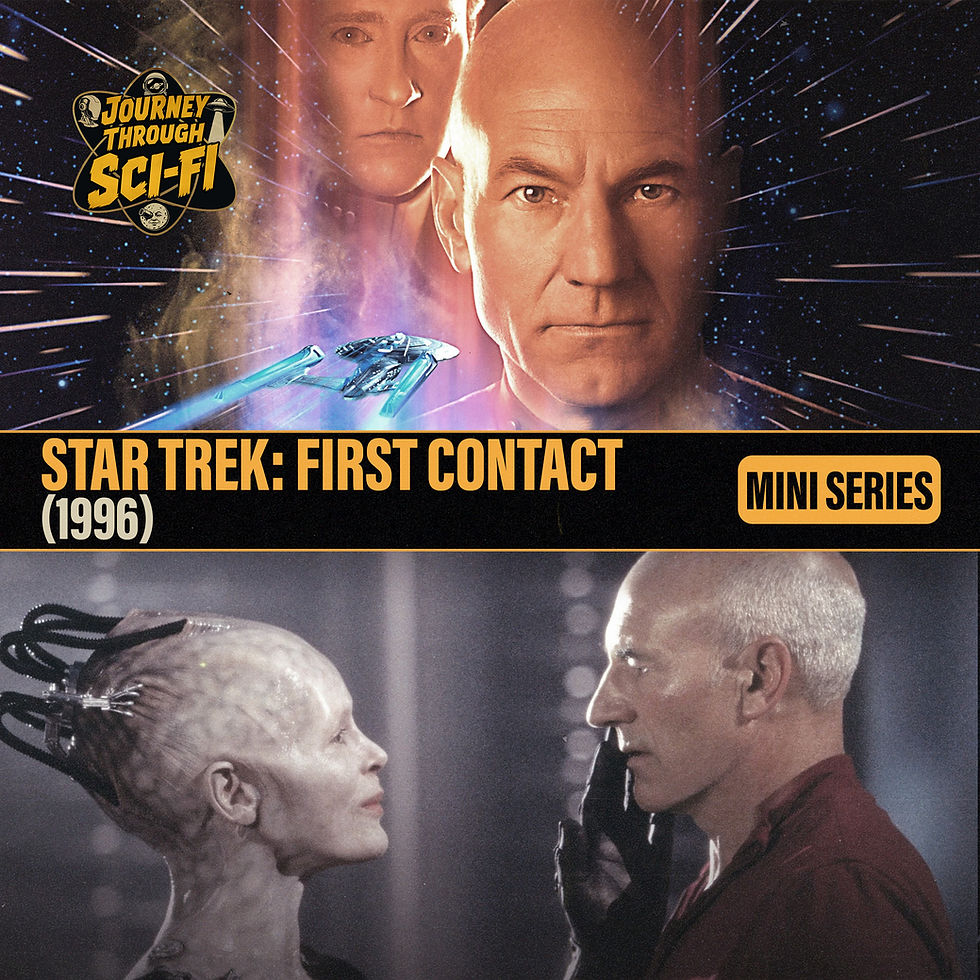

So the question we keep coming back to on this one is a film history question: what actually changes when a TV crew goes to the cinema? Television has to reset. Whatever happens to Picard this week, he has to be back in the chair, composed, by the next one,. A film doesn't reset. So First Contact gives everyone new uniforms, a new ship and a new bridge, then lets Picard do what the show never could. He calls Worf a coward. He smashes a cabinet of model starships. He gets compared to Captain Ahab by the one person on board who isn't Starfleet. It's full Shatner, and it works, because Stewart lets the regret land on his face after every line and carries on anyway.
In this episode we get into Starfleet finally fighting as a fleet (with Adam Scott at the helm of the Defiant), Picard picking up a phaser rifle and sweating through his big speech, the Borg Queen lowering into her own body in a shot that has aged like fine wine, Data's emotion chip finally earning its place, and a Data and Borg Queen moment one of us thinks is handled brilliantly and the other laughed out loud at. Plus how much is borrowed from The Voyage Home, The Wrath of Khan and The Undiscovered Country, how Alfre Woodard turns an audience surrogate into one of the best things in it, the worst line in the film (it's the name of the franchise), why the title is rubbish, and whether it beats Khan.
Pour Zefram Cochrane a stiff one, keep your mag boots on, and settle in.
Listen now on Patreon.
Journey Through Sci-Fi is a sci-fi film history podcast hosted by James Payne and Matt Willcock, taking one big science fiction idea through the decades, two films at a time.
For more like this, dig into the back catalogue here at JourneyThroughSciFi.com or sign up to the JTSF Logbook newsletter.


Comments