
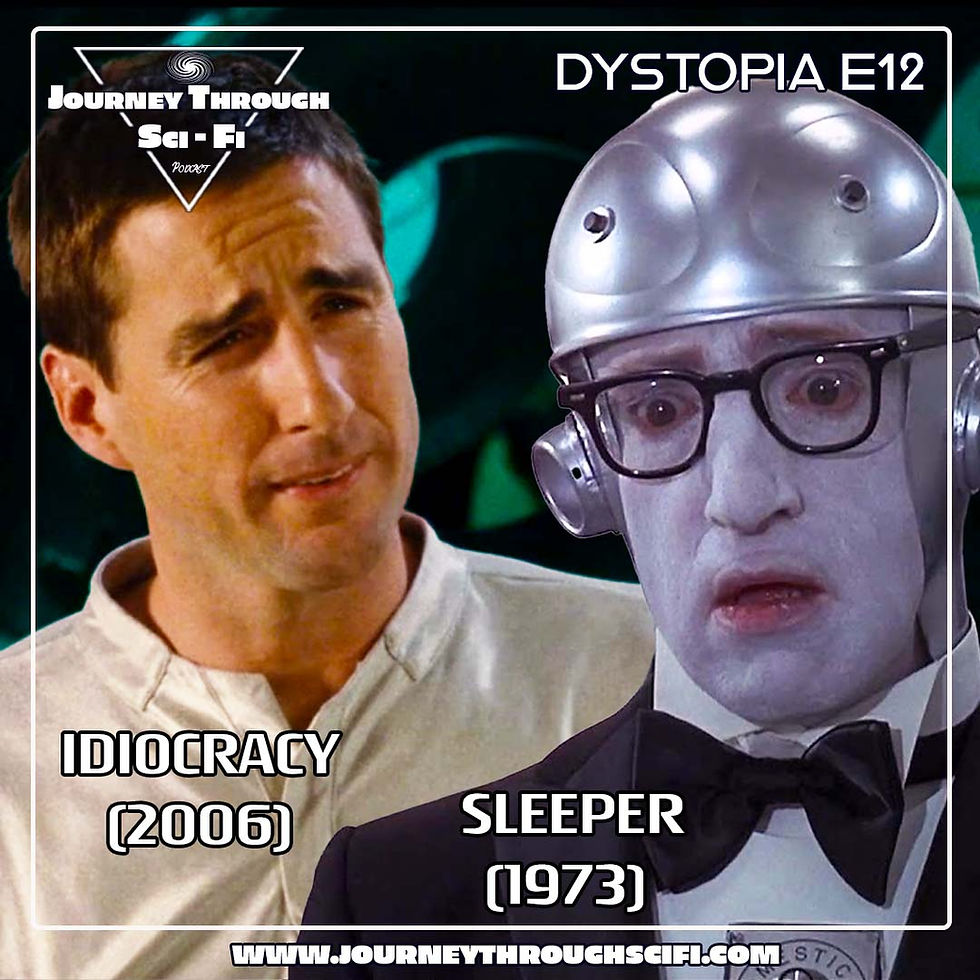
Sleeper (1973) & Idiocracy (2006): Satirical Sci-Fi Futures | EP12
Updated: Mar 10
In this episode of Journey Through Sci-Fi, we take a short break from the darker dystopian worlds we’ve explored so far and look at a different approach to the genre: comedy.
Dystopian science fiction is often associated with bleak futures and authoritarian societies, but some filmmakers have used satire and humour to explore the same ideas.
This week we’re discussing two films that imagine absurd future societies while poking fun at the present day.
Because here on Journey Through Sci-Fi, we explore the history of science-fiction cinema one subgenre at a time.
LISTEN BELOW:
What We Discuss In This Episode
In this episode we talk about:
Satire and comedy in dystopian science fiction
How humour can critique politics and culture
The role of exaggeration in speculative storytelling
Why dystopian comedy often feels uncomfortably close to reality
How these films reflect anxieties about society and human behaviour
Sleeper (1973) – Woody Allen’s Futuristic Satire
Sleeper is a science-fiction comedy directed by and starring Woody Allen.
The film follows Miles Monroe, a New York health-food store owner who is accidentally cryogenically frozen in 1973 and revived 200 years later in a bizarre dystopian future.
In this future society, the United States has become an incompetent police state ruled by a mysterious dictator known only as The Leader.
Miles becomes involved with a rebel movement attempting to overthrow the regime, leading to a series of increasingly absurd situations involving disguises, futuristic gadgets and slapstick chaos.
The film parodies both dystopian science fiction and the political anxieties of the 1970s, combining sci-fi ideas with the physical comedy traditions of silent-film legends like Buster Keaton and Charlie Chaplin.
Idiocracy (2006) – A Future of Anti-Intellectualism
While Sleeper satirises authoritarian politics, Idiocracy takes aim at modern culture itself.
Directed by Mike Judge, the film follows an average man named Joe Bauers who volunteers for a military hibernation experiment and wakes up 500 years in the future.
Unfortunately for Joe, the future he wakes up in is a world where society has become dramatically less intelligent, dominated by consumerism, anti-intellectualism and media spectacle.
Infrastructure has collapsed, political leadership is incompetent, and the population spends most of its time watching crude entertainment.
The film exaggerates contemporary social trends to create a dystopian comedy that has developed a strong cult following.
Satire as Dystopian Critique
Both of these films demonstrate how comedy can be used to explore dystopian ideas.
Rather than presenting bleak authoritarian worlds, they imagine exaggerated futures that highlight the absurdity of social and political trends.
In Sleeper, the satire targets political power and authoritarian control.
In Idiocracy, the target is consumer culture, media influence and declining intellectual curiosity.
Although they approach dystopia through humour, both films still ask the same question as more serious dystopian stories:
What kind of future are we creating for ourselves?
Continuing Our Journey Through Dystopia
This episode forms part of our Journey Through Dystopia series.
Across the series we explore how science-fiction cinema imagines societies shaped by authoritarian power, environmental collapse and social control.
From bleak dystopian classics to satirical comedies like Sleeper and Idiocracy, these stories reveal how science fiction reflects humanity’s fears — and sometimes its sense of humour — about the future.
Start Your Journey Through Sci-Fi
Journey Through Sci-Fi is a podcast exploring the strange, visionary and world-changing history of science-fiction cinema.
Each series focuses on a different sci-fi theme — from space exploration and artificial intelligence to time travel, virtual reality, cyberpunk and dystopian futures.
Join us as we explore the films and ideas that shaped science fiction.


Comments